House committee passes two Medicaid-related bills
By Wyoming News Exchange
February 24, 2026
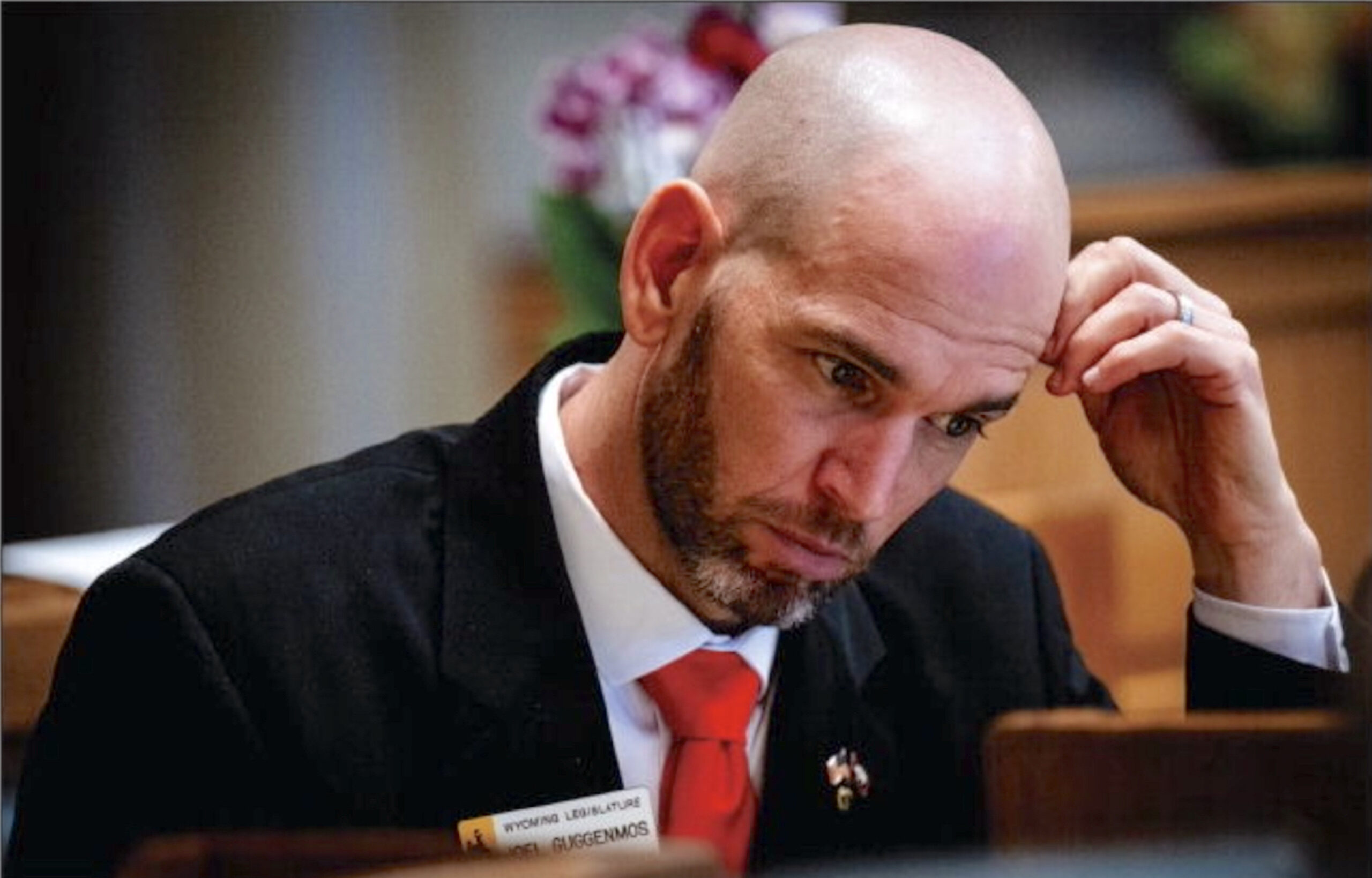
Rep. Joel Guggenmos, R-Riverton, looks at his notes in the House chamber during More the 68th Wyoming Legislature’s budget session Feb. 9 at the state Capitol. Photo by Milo Gladstein, Wyoming Tribune Eagle.
By Carrie Haderlie
Wyoming Tribune Eagle
Via- Wyoming News Exchange
CHEYENNE — Despite one lawmaker’s suggestion that Medicaid patient ambulance services be paid for with one-cent sales tax funding, a House committee voted Monday to increase the Medicaid rate for EMS services in Wyoming.
The House Labor, Health and Social Services Committee voted 5-3 in favor of Senate File 4, “Medicaid rate increase-EMS services,” which increases ground ambulance reimbursement from 66% to 100% of the Medicare rate for Wyoming residents who are already on Medicaid. Rep. Pam Thayer, R-Rawlins, said she supported SF 4, as EMS services are so crucial to rural Wyomingites. Thayer, who represents House Districts 47 and 15 in Carbon County, said her area is one of the largest and most rural districts in the state.
“We’re almost 8,000 miles,” Thayer said. “I can tell you that we have (EMS) volunteers that are going from Rawlins … over to Saratoga, so they just have to even get to that ambulance bay” 40 miles away, and continued funding is necessary to ensure an ambulance arrives when someone needs one.
“I am absolutely in favor of this, and it is really important for our county,” Thayer said.
Rep. Joel Guggenmos, R-Riverton, said that the funding in SF 4 is not nearly enough to cover the issue the bill does not think “outside the box.”
“It’s putting this on the state to try to solve it with money,” he said. “I like the idea of — with the diversity of our communities, size and distance — I would like to see it be more locally addressed” through something like a 1% optional sales tax.
“If there is a real need, people will vote for it, and if there is not, if things are working well, it won’t be voted for,” he said.
SF 4 includes an appropriation of $1.3 million from the state’s general fund as well as an additional $1.3 million in federal funding, according to House Labor Committee Chair Rep. Rachel Rodriguez-Williams, R-Cody.
Franz Fuchs, Wyoming Department of Health deputy director, explained that ground EMS includes ambulances that respond to 911 calls, as well as those that transport people between hospitals. In Wyoming, there are 44 EMS providers that service approximately 77,000 calls per year, but geographically, those calls are quite varied. Medicaid funding is allocated on a “fee for service” basis, Fuchs said.
“For every transport, and every time they take a call and take a Medicaid patient to the hospital, they will get paid a certain amount of money. This bill raises that price that we’re paying for that trip,” Fuchs said. “It is essentially allocated for the number of trips throughout the state.”
A major cost is readiness, Fuchs said, to keep EMS services available 365 days a year, 24 hours a day. In very small communities, that cost is subsidized by volunteers; however, Fuchs said, the cost does not go down from about $500,000 per year, no matter the community, because equipment must be ready and staff must be on call — regardless of whether they’re paid or volunteer.
“There’s a service out in the eastern part of Laramie County, Albin Rescue,” he said. “They responded to 18 calls in one year. You have a very high fixed cost of readiness, but you only respond to 18 calls.”
Jesse Springer, Medicaid director for WDH, said the reimbursement rate for EMS services has not increased in about 10 years.
The committee also passed Senate File 6, “Eligibility for Medicaid- criteria,” out of committee Monday morning.
Rodriguez- Williams said the measure codifies rules, including proof of citizenship and Wyoming residency requirements, for Medicaid patients.
Springer told the committee that SF 6 was “heavily amended” in the Senate to add specifically noted groups covered under Medicaid, like tuberculosis patients, as well as treatment for breast and cervical cancer. Medicaid services covered, if SF 6 passes, will be authorized by the Legislature.
“If the Legislature would like to add a population or procedure, they can now go into this new section of statute, and specifically add that obligation,” Springer said.
Although there was no additional public comment Monday, Healthy Wyoming, a coalition of organizations, providers and community members with a mission to ensure citizens can access affordable, high‐quality health care, has expressed concern over SF 6.
Healthy Wyoming says the measure would make it harder for Wyoming families to get health coverage, as well as hamstring future lawmakers to respond to health and economic developments.
“Senate File 6 is a ‘no‐flexibility’ bill,” said Marguerite Herman, chair of Healthy Wyoming, in a press release last week. “This bill proposes to hard‐code today’s restrictive Medicaid rules into law and says that even if circumstances change, Wyoming can’t expand eligibility without jumping through extra political hoops. That’s bad news for working families, rural hospitals, and the long‐term health of our state.”
The above story may be used ONLY by members of the Wyoming News Exchange or with the express consent of the newspaper of its origin.