
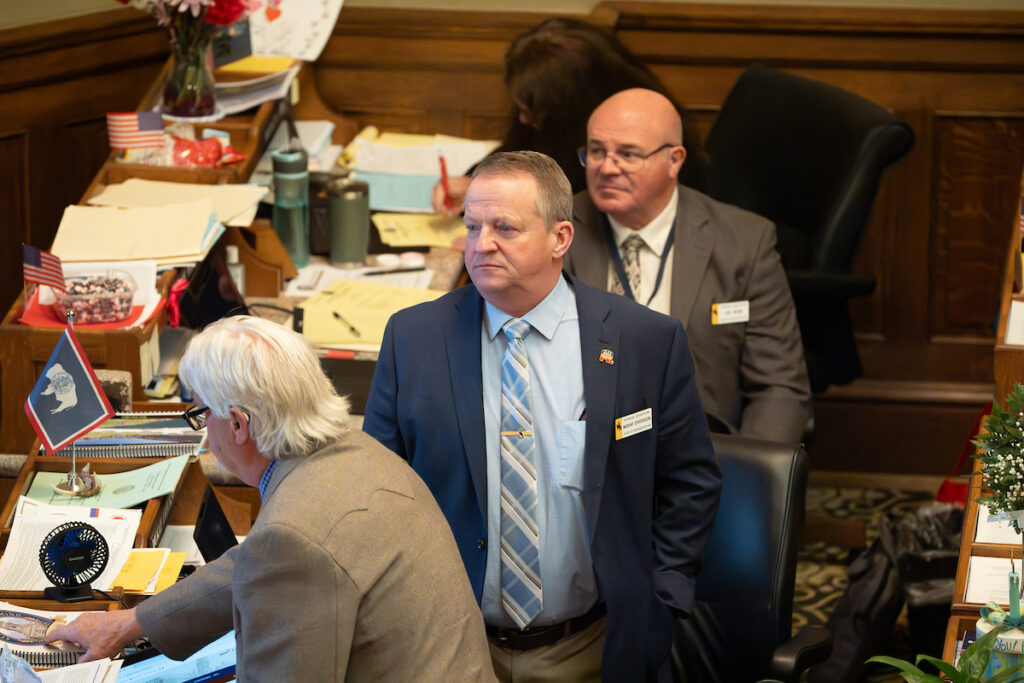
Rep. McKay Erickson (R-Afton) stepped into the SVI Radio studio on Thursday, May 21, to share his thoughts on the school funding recalibration bill passed this year by the Wyoming Legislature.
Rep. Erickson’s comments come at the conclusion of a series of conversations with local school officials and lawmakers. Below are links to all previous interviews. SVI will revisit the discussion after committee meetings discuss potential changes to the bill in June.
Rep. Scott Heiner (R-Green River)
LCSD#2 Superintendent Matt Erickson & Director of Finance JC Inskeep
Swift Creek High School Principal David Cazier
Cokeville Principal Kenneth Deitz
WHSAA Commissioner Trevor Wilson
(0:00) On the weekday, wake up at 835 this morning, it is the weekday (0:07) wake up on Swift 98 and the spur heading into our guest (0:10) interview segment for this hour today, Representative McKay (0:13) Erickson from House District 21 in Star Valley, joining me live (0:16) in studio this morning, Representative appreciate your (0:19) time today. I know you probably have one or two other things you (0:21) could be doing this morning. So thanks for for working us into (0:24) your schedule today.
(0:25) You bet I’m always glad to join you Duke and appreciate you the (0:29) parts that you play in getting information out and all sides of (0:33) the issues. And I think that’s a great thing. So thank you for (0:36) having me in here.
(0:38) Well, we’ve had an ongoing series of discussions regarding (0:40) the school recalibration bill, which of course was passed by (0:43) the state legislature this year. Wanted to get your thoughts on (0:46) it. We’ve talked with some other lawmakers and school (0:48) administrators on this.
So where would you like to start on on (0:52) the school recalibration bill? (0:54) Well, I’d kind of like to do it a little bit different. Because (0:56) like you said, we have had a lot of discussion about it. And you (1:00) know, we could go back and forth and crunch the numbers and put (1:03) statistics and different things like that.
I think those have (1:06) been covered fairly well. So I’d kind of like to go on on where (1:10) it’s headed, maybe give a little history of the whole process and (1:16) then where it’s headed now. So I think that might be interesting (1:19) to our to our listeners and to the constituents here.
I express (1:24) start off with expressing quite a bit of optimism, even though I (1:28) feel like it’s somewhat too late, I not too late in the (1:32) overall things I think things can still be done. But what I (1:35) say is too late in too late, meaning that, you know, I wished (1:39) we would have had this at the first of this recalibration (1:42) bill, the public participation, because they they they have got (1:46) involved, and they’ve done their homework, and they have come (1:49) forward and ask questions. And, and it’s caused us to what I (1:53) think is a good rethinking process, and that there’s some (1:58) positive changes that could come out of it.
And so I commend (2:02) those people that have that have got involved in and really (2:05) dug in and, and found out how it affects them personally, or (2:09) their student or their community or their school, you know, (2:14) because we’re so interdependent on each other in, in Wyoming. (2:17) And that’s what makes us us great. So that’s been great.
(2:22) But I want to talk if it’s okay with you, the reason that it (2:30) kind of went through and the reason that and one of the most (2:33) common criticisms is it, it was just rushed through, and it (2:37) didn’t actually dig into the details as to how it was going (2:42) to affect the schools now that and we have to admit it, it’s a (2:47) major change in how we fund public schools. Yeah, there’s no (2:51) doubt about it. It’s changed that significantly.
And so there (2:54) couldn’t help but be some some hiccups have some of them have (2:58) caused them, or some have called them. But in in in my mind, and (3:04) in a significant amount of individuals mind, it was it was (3:09) it, it headed down the wrong path. And it ended up with (3:14) something that the targets going to have to be obviously moved in (3:19) order to make that successful.
And so well, and as you and I (3:23) have talked about in the past in previous discussions that there (3:26) was lawsuits against the state because their recalibration (3:30) hadn’t happened for so long, right? (3:32) Exactly. And that’s, that’s got point that I’d like to make is, (3:35) you know, this major court ruling said we have been under (3:39) funding for years. When when I say we the legislature has been (3:43) under funding, and it was clear.
I mean, it was it, everybody (3:46) expected it. I don’t think anyone thought that the court was (3:50) going to come in and say, Oh, yeah, because of missing these (3:52) years of putting money into the education, you know, whether it (3:57) be for regional cost adjustments, whether it be for (4:02) additional students that we had moving in at one time, you know, (4:05) it, it just wasn’t meeting the bar. And so that was a big (4:08) reason that it was there.
And then, and then another pressure (4:12) item, I believe was teachers, there’s no doubt about it, (4:17) teachers needed more money, we found that we couldn’t hire in (4:20) the state of Wyoming, we couldn’t retain very well, I (4:23) mean, we were even losing teachers to states that (4:26) typically haven’t been able to come and grab teachers, you (4:30) know, and then our cost of living went up. And, you know, (4:33) all those different economic factors definitely played into (4:38) that. And so everybody along the spectrum, agreed, we’ve got (4:42) to get teachers more money.
That’s all there is to it. And (4:45) so then the, the debate picked up, well, how we how are we (4:50) going to do that. And that was one of the things.
And then, of (4:53) course, there’s always the pressure on, are we getting our (4:56) bang for the buck, you know, there was this definite in the (5:00) last few years, public school is losing some students, the state (5:06) of Wyoming is losing students, and whether you go private (5:09) school, charter school, whatever, our numbers are (5:14) dropping, even in places like Star Valley, that’s still (5:16) growing, there were not growing with a lot of families, you (5:21) know, so that was another reason that we took, we took aim at (5:25) that and and really thought that this was needed, a needed bill (5:30) to be done, because we hadn’t done so but I think probably the (5:34) most pertinent pressure was those court cases. And whether (5:40) or not we actually satisfied those court cases, with this (5:44) recalibration bill is up for debate. I don’t I don’t think (5:47) it’s even close.
So there will be too much. (5:51) Gotcha. Gotcha.
So you mentioned a couple of items in (5:54) there, of course, the the teacher funding increases and (5:57) the salary increases that that’s obviously happened, it came in (6:00) the form of the silo that we’ve talked about. So touch on that (6:04) a little, if you would, in your thoughts on on not just the (6:07) funding increase for teachers, but the the change in in the (6:11) model to fund the teachers. (6:13) Yeah, well, you know, we talked, we keep hearing from some of the (6:16) founders of this or some of the authors of this particular bill, (6:20) oh, we put $100 million of additional money into this (6:26) funding model, this that’s got to be enough.
Well, we have to (6:29) look back, it kind of comes with a caveat there in that we (6:34) we we haven’t funded for so many years. So some look at it like (6:38) that $100 million was to make up for the 15 years that we’ve (6:43) underfunded. You know, so so is it really new money that’s put (6:47) in education? Or is it money that was supposed to be in there (6:51) and and and slowly being infused into education because of the (6:55) increasing costs and different things like that.
Because (6:58) remember, we, we still talk about the significant portion, (7:01) I and I’m not exactly sure, but it’s in the 90s. I’m going to (7:04) say 93% of Wyoming students are served by public schools. And (7:09) and in in my mind, and a lot of people’s mind very well served (7:13) in that.
So so we’ve got to we’ve got to we’ve got to focus (7:17) on the majority and not the minority when it comes to making (7:21) sure that that that large group of people is is actually going (7:25) to be funded. And just touching on that, where we’ll go into (7:30) the silos, but when it was rolled out, if you remember, (7:34) much to their dismay, and and much to what they’re saying (7:40) right now, there were a lot of red flags that went off Duke, (7:44) they were they were raised very 48 of 48 districts when this was (7:49) first rolled through. And and we were getting ready for the (7:52) legislative session, and they had the bill ready to present (7:55) 48 of 48 opposed it.
Now they know that that doesn’t include (8:01) just your administrators coming in. That includes the entire (8:04) school district, including school board members. I saw (8:08) them there.
They were they were lining up to testify about (8:12) excuse me, what the what this was going to do to the (8:16) education in Wyoming and and then moving through it. If you (8:21) remember, it was supposed to start in the House of (8:24) Representatives, this bill, it failed twice being introduced (8:28) red flags there. And even though it only took 21 to stop that (8:33) because it was a budget year.
21 stopped it from being (8:37) introduced. And we had a feeling that there was so much (8:40) inability to convince individuals in the house to (8:45) break away from that block vote, that they all block or that (8:49) they all vote in. We didn’t think that that was going to be (8:53) successful in getting it changed, because the way it (8:55) got introduced, it’s significantly changed once it (8:59) got to the Senate.
The Senate did make some changes, good (9:02) changes. But but but there was that there was the (9:07) recalibration bill had as much attention and interest in it as (9:12) did any of the other bills, you know, down there and and it (9:16) wasn’t it wasn’t good. It wasn’t patting each other on the (9:18) back saying, Oh, yeah, we’ve hit the target here.
This is (9:20) great. And it wasn’t that. And so that that that led a lot of (9:25) concern.
Once it got to the house, it had hundreds of (9:28) amendments. Most of those amendments died, we did, I think (9:35) one of the gentlemen said yesterday that they accepted two (9:39) amendments, two or three amendments. But there were (9:42) hundreds attempted, and hundreds attempted at what you mentioned (9:45) earlier, and that was piercing the silo.
That is the new idea (9:51) about putting it lock, lock tight into a silo to where it (9:58) goes in with one intention, it comes out with one intention. (10:02) That’s not similar to the block grant, the block grant allowed (10:08) districts to look at their needs and say, this is what we want to (10:13) happen with this money. The claim being that school (10:17) districts were getting the money for teachers, but not using it (10:19) for teachers, right.
And and when the numbers come out, and (10:24) and when they, like, for example, I know that there was (10:28) one representatives that was challenging Cokeville to go and (10:31) say, did you get your 8.3% raise, you didn’t get it. Once (10:36) they looked at insurance costs, once they looked at, at (10:40) salaries, once they looked at other benefits for teachers, you (10:43) dang rights, they got it. And so they, because of a few bad (10:48) districts statewide, that may have been over messing with the (10:54) money.
The majority of those 48 school districts, they do it (11:00) closest to the people. And that’s through school boards and (11:03) school boards determined the ultimate as to where that money (11:07) goes. And so that that that simply was was overblown as to (11:13) the the ones that were not doing that correctly.
But again, it (11:17) focused on that and this kind of almost become a wedge that they (11:22) tried to drive in between that teachers and the rest of the (11:26) school district because everybody agreed teachers need (11:29) the money. It was just up to how are we going to do that? How are (11:33) we going to get that in their hands? And he’s we, we found (11:38) out that many districts were already paying teachers over (11:40) what the model gave. You know, they were they were using some (11:44) of this additional money or money that they got through (11:49) saving on one program or the other saving on, you know, the (11:53) amount of teachers that they needed in the classroom to (11:56) still meet the state demand.
So you know, they there, there was (11:59) a lot of ways that they went about it, went about doing it. (12:03) Representative McKay Erickson in studio this morning talking (12:05) about the root school recalibration bill. Let’s talk (12:07) about funding for support staff and then activities and talk (12:12) about some maybe future changes to this recalibrate bill that (12:14) you might see in the in the future because those those two (12:16) items have also been discussed quite a bit.
(12:18) Oh, yeah, that’s, that’s good. That’s, that’s, you know, this (12:22) this silo is, is fairly tight. It, it, it has a fairly narrow (12:29) scope as to where the teacher funding can go and, and where (12:34) it can pay out.
So there are missing categories and I wished (12:38) I had a list of them here, but just, you know, our mental (12:41) health folks, librarians, groundskeepers, things like (12:46) that, I know were left out of the, out of the silo. And, and (12:51) yes, there is, there is some that were retained in there and, (12:55) and, you know, teaching certificate wise and what (12:59) certifications you had. But overall, we, we, we did, and (13:04) maybe it was inadvertently, I hope that we can come back and (13:08) change that.
But it takes a village to put a school district (13:12) together. And, and it’s not really fair that we are going (13:17) and saying, yeah, look, here what we did, but we don’t have (13:20) to worry about this because this is kind of the big visual (13:23) one and, and needed one, you know, we, we, we should be (13:26) careful where we’re hooking our wagon, so to speak to that. (13:29) So there, there were, I mean, even on the legislative website, (13:32) you could, you could see a chart that it says, okay, here’s (13:36) money in the silo for teachers.
Here’s money outside the silo (13:40) for support staff. And so maybe, maybe explain that. (13:43) Yeah.
And, and, and again, it, it specifically spent time (13:47) trying to decide where could we go to, to find some other money (13:54) through what the state sends in that block grant to, to make (14:00) sure that everybody was accounted for. But I think (14:03) bottom line, it ended up not having enough and it, it (14:09) prioritize some over others without outside of that silo. (14:13) And, and that was the concern.
Just briefly touching on, you (14:18) know, kind of what were some trade-offs that were criticized? (14:21) Well, of course, class size went up. No monies could be (14:25) moved. Definite loss of local control was, was something that, (14:31) that a lot of people had the concern over and the state (14:35) basically is going to pull and hold the purse strings, which (14:40) was talked consistently about throughout the entire budget (14:45) session, whether it be education or general spending.
And that (14:48) was there, there, that they, that the proponents of this (14:53) bill, they, they definitely want to make sure that they’re in (14:57) control and who gets what, you know, some of the suggested cuts (15:01) to the university of Wyoming. Well, we’ll give you this money (15:04) if you change one of your departments or you change a (15:08) description of a class and things like that. That hasn’t (15:11) been the way we do business in the state of Wyoming.
You know, (15:14) we trust those people that are on the ground, boots on the (15:17) ground that are there in order to go forward with it. So I (15:22) don’t know. I, I, I especially feel that kind of coming back (15:28) to that now, Duke, as we, we started off, I, I feel like (15:33) because of the public participation and people coming (15:36) with real numbers and saying, how can you explain this? (15:42) Because this is what it’s going to do to us as a, as a school (15:44) district.
And so I think that’s been a great process and a (15:48) process that we need to have more of because I, I, you know, (15:53) they talked about, oh, it was something that 93 of the, all (15:59) 93 of the legislators missed. No, we didn’t. And I don’t mean (16:03) to say, I told you so, but I was one of the seven that voted (16:07) against this recalibration because I saw these exact (16:10) things.
And I’ve been a big advocate of, of, uh, across the (16:16) board participation in all of these activities, not just (16:19) sports, but all these activities, we could see it (16:22) coming. We had athletic directors. We had, uh, (16:26) activities directors from across the state come in and testify (16:30) in those committees in education committee saying, it’s not (16:35) going to leave enough.
And it’s going to hurt, especially these (16:38) smaller schools that are hooked to the larger schools, because (16:42) just to throw out some numbers there, the state pays 800 and (16:46) some odd dollars per student participating in Lincoln County (16:50) school district. And it costs Cokeville because they’re a (16:54) small school custom about $2,300. How do you make that up? (17:00) We used to be able to make it up.
It hasn’t been that they’ve, (17:02) they’ve paid for every dollar of that in the past. So how do you (17:05) make up from 800 to 2,300? You know, so those are some real (17:10) facts that I, I, I anticipate them very much deeply diving into (17:17) it. And, and I, you know, I hope that they’re listening just out (17:19) of the, the intent of, of really that I believe most people are (17:24) on the same page wanting to improve.
I hope it’s not just (17:29) because of this election year that they’re listening, but, but (17:32) the people of Wyoming have definitely spoke and said, this (17:35) is going to be a priority going into this election. (17:39) Representative McKay Erickson in studio. So of course, even (17:42) before an election takes place, there’s going to be some (17:44) committee work happen on this.
And so what do you anticipate (17:47) happening or what, what is scheduled at least at this (17:50) point to take place now? (17:51) Yeah, well, the recalibration committee meets, I believe it’s (17:55) the 24th and 25th. And I keep getting my dates back and forth, (17:58) but it’s right around there that they meet in Lander and, and (18:02) they’re preparing July, June, right? Yep. Of June.
And they (18:06) are, according to some of the things that they’ve been (18:10) talking about some of their recalibration talks and had a (18:15) Facebook live last night that said, we’re, we’re all ears on (18:19) the 24th. And so hopefully that will be one of the first ones. (18:24) However, we meet as a, as a committee, education committee, (18:30) joint education committee on the first and second of June in, we (18:37) meet in Casper on that at that time.
And so I think that there (18:41) will be plenty of discussion going on there, because that’s (18:44) one of the interim topics we selected, we can’t change the (18:47) recalibration bill. But we can certainly understand the (18:51) funding, so that it’s not sometimes placed behind smoke (18:55) and mirrors to, to get you to, to back off, you know, and so I (19:00) think that will be great. So, so June is going to be a big (19:04) month for it, you know, because it is before the elections and, (19:08) and, and people are, people are already making their plans to (19:14) pack the house and, and make sure that they’re, that we are (19:18) listening to what they have to say.
And I’m sure that they’re (19:21) going to be some, some very good people that testify and (19:25) some good discussion on that, because even though maybe it’s (19:29) been led to believe that it was a 12 to zero recalibration (19:34) committee that voted it out of the committee, it’s anything (19:39) but 12 to zero. I mean, they, they, they, there were plenty of (19:43) them that were plenty, at least four of them that I’ve talked to (19:48) individually that said, you know, it’s not, it’s not great, (19:53) but we’re, the court’s looking down the barrel and we are (20:00) definitely wanting to get something passed because we (20:03) haven’t. And I think that kind of led to the, the frenzy of, of (20:08) pushing it through and, and getting it there.
So there, (20:10) there’s, there’s people that have taken notice and there’s (20:13) people that even voted for the recalibration, just read one the (20:17) other day, a very well respected legislator from up in (20:21) Warland. And, and she’s like, this, this is not what I voted (20:27) for. You know, I mean, it’s not, it’s not turned out to be (20:30) that.
And, and once the numbers actually hit the, the paper, (20:35) they’re not, they’re not beneficial to, especially the (20:38) small districts. And, and of course that leads right into (20:41) the, the activities portion, which makes up our culture, (20:47) makes up our style. It makes up our communities.
You know, (20:51) that’s just the way we do things. And that’s the way we’ve (20:55) developed and built up the, the strong efforts there by our (20:59) coaches, our advisors, and, and different things like that. (21:03) They’re as big of an important part of this as, as anyone in (21:07) education.
(21:08) It’s representative McKay Erickson of Star Valley (21:10) discussing school recalibration. Appreciate your (21:12) time representative. And I’m sure after the summer, we’ll, (21:15) we’ll chat again and get some updates on it.
(21:17) You bet. Thank you. And I appreciate again, just the (21:20) ability to get information out and get accurate information (21:23) out and, and, and, you know, maybe tell some of the side (21:26) stories and the background because a lot of people don’t (21:29) understand how this long process works and it’s, it can be a (21:33) grind, but it’s worth it.
You know, it’s, it’s, it’s where we (21:36) want to be. So thank you. (21:38) Representative McKay Erickson, House District 21 in Star (21:40) Valley.
It’s all part of the weekday wake up this morning on (21:42) SVI radio.