By Marit Gookin
The Ranger
Via- Wyoming News Exchange
RIVERTON — Not every Wyoming school district lost out in the recent school finance recalibration’s changes to the funding model. But for those that did, one of the areas that was often hit hard was an area schools had already been forced to paper over, educators testified.
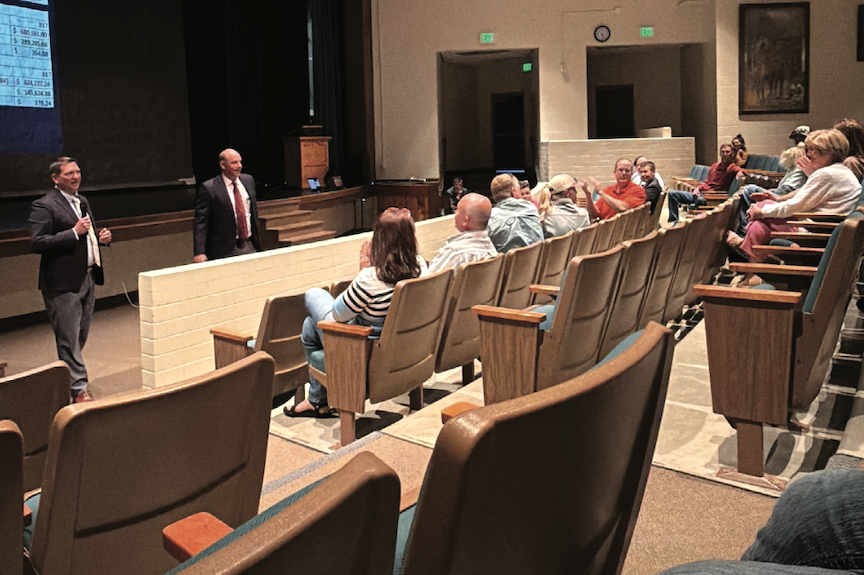
“Activity funding for all schools in Wyoming needs to be increased, as previous funding was inadequate,” Cokeville Schools Principal Kenneth Dietz told the Select Committee on School Finance Recalibration.
RELATED: PRINCIPAL KENNETH DIETZ DISCUSSES IMPACTS OF SCHOOL RECALIBRATION –
Recalibration, it became clear throughout testimony Thursday afternoon, didn’t create the gaps many Wyoming school districts face in activities funding out of whole cloth. Rather, it exacerbated an existing problem.
Matt Willmarth with the Wyoming Legislative Service Office explained to the committee that Wyoming schools have been making up the funding gap for activities for over a decade; in 2024-25, he said, Wyoming public schools spent $4.3 million out of their general funds to help cover the shortfall. Now, schools face an additional $3.9 million decrease in activities funding.
And this isn’t, Campbell County School District #1 Superintendent Alex Ayers testified, shocking news for himself and others who were involved the last time Wyoming adjusted its funding formulas.
“It’s never been cost-based,” he described Wyoming’s funding of school activities. “It was designed from the very beginning to not [fully] fund large districts.”
While the changes made during the 2026 legislative session are numerous, two factors in particular have had significant impacts for schools: A shift from school-based to district-based funding, and the siloing of funds that decreased districts’ budget flexibility.
The case of Cokeville
For Cokeville, and four other small schools attached to large school districts, the change in funding models didn’t just mean a decrease in funding, Dietz said; the change meant no funding for their activities at all.
“This legislation created a $130,000 hole in Cokeville activities that would have killed all activities in Cokeville in a single year,” he explained.
For years, he said, Cokeville received funding inadequate to support its activities and staff salaries appropriately. It chose to hire fewer staff members, he said, and everyone in the district was aware of the tradeoff.
Taking away the ability of the district to make choices about what to do with its limited funding, based on the input of local constituents, was a huge overreach of state government, Dietz commented.
Committee Chairman Rep.Scott Heiner, R-Green River, said he first became aware of the issues with activities funding when Cokeville parent Shannon Davis brought her concerns to him.
“It costs more to run athletics for small schools than it does for large ones,” Davis told the committee Thursday. “This education system is at the heart of our town.”
When the school funding formula was last changed in 2005, Ayers explained, there was a hang up at the very end. At that time, he said, Campbell County proposed something that it knew would hurt it and other large school districts in terms of activities funding – and that is the model that moved forward.
Ayers and other superintendents in his position, he continued, frequently get “beat up” in these public discussions about spending more money than they get. He would appreciate, he told legislators, some acknowledgment that districts like his can’t fully fund activities with the money they get.
Sen. Chris Rothfuss, D-Laramie, noted that while the problems caused by recalibration and the instructional silo were not intended, the changes have revealed problems that schools have been papering over by shifting funds around.
For his part, Johnson County School District #1 School Board Chair Travis Pearson told the committee that the instructional silo solved a problem that didn’t exist.
Wyoming schools were already largely paying educators more than what the state allocated for, and the last time the legislature approved an 8.5% raise to the base funding model, his district took those additional funds and gave every district employee a raise.
Primarily what recalibration and the instructional silo accomplished in terms of JCSD#1, he told the committee, was to prevent the district from spreading the raises across all of their employees equitably and to leave it with a 50% shortfall in its operations funding.
Best of
“Parents in Lander, myself included, are very aggravated about this — very, very angry,” Randy Wise said. “Activities make the students. They make the communities, as well … Doing what the plan is now is hollowing out these communities.”
He appreciates, he added, that the committee appears to be taking those concerns seriously.
Committee members discussed several possible paths forward, including returning to the old funding model or allowing districts to use a certain percentage of instructional silo funds for activities.
By shifting to a district-based rather than school-based approach, Willmarth explained, the legislature effectively reversed which districts win or lose out on funding in a given category. Going back to the old model would just change which districts lost or won, not solve the problem.
School finance consultant Dr. Larry Picus added that even allowing 1% of the instructional silo to be used for something noninstructional would remove the power of the silo – and raise the policy question of whether activities count as instructional.
What, Rep. Mike Yin, D-Jackson, asked Willmarth, if they did “best-of?”
Going with an approach that would allow for the model that would offer a school or district the greatest amount of funding would resolve the issue of some districts losing out under one approach or the other, Willmarth responded.
The committee seemed largely amenable to Yin’s suggestion, and during public comment Heiner consistently asked speakers what they thought of the idea. While most speakers were supportive, a few noted that it doesn’t address the issue of activities funding having never accounted for actual costs.
Mara Gans, who sits on the Fremont County School District #1 school board, said that Wyoming should work toward cost-based activities funding – and look at school activities as a solution to some of Wyoming’s other costly problems, such as health and incarceration rates.
Wyoming School Boards Association Executive Director Brian Farmer remarked that the actual activities shortfall isn’t just the gap some districts face now. Together, the current $3.9 million shortfall and the approximately $4.3 million districts have been spending out of general funds add up to something more like a $7 or $8 million gap between what the state has provided and what districts are actually spending.
Nonetheless, the committee appeared to favor the best-of or greater-of option as something that could pass during the next legislative session to help districts in the immediate future, and potentially even be backdated to allow districts to use the additional funds for the current fiscal year.