By Owen Houtakker
Wyoming Tribune Eagle
Via- Wyoming News Exchange
CHEYENNE — Wyoming and all other members of the Colorado River Basin hope for large snowpacks this year to boost water levels in Lake Powell.
That was the prevailing, if unsurprising, sentiment Friday as the Wyoming Legislature’s Select Water Committee received an update on the Lower Basin water level, as well as ongoing litigation that could upend the agreement’s current framework.
The update was provided by Wyoming State Engineer Brandon Gebhart, who first noted that a meeting would be held this week by the Upper Colorado River Commission to discuss a grant implementation agreement tied to conservation efforts in the Upper Basin states, which include Wyoming.
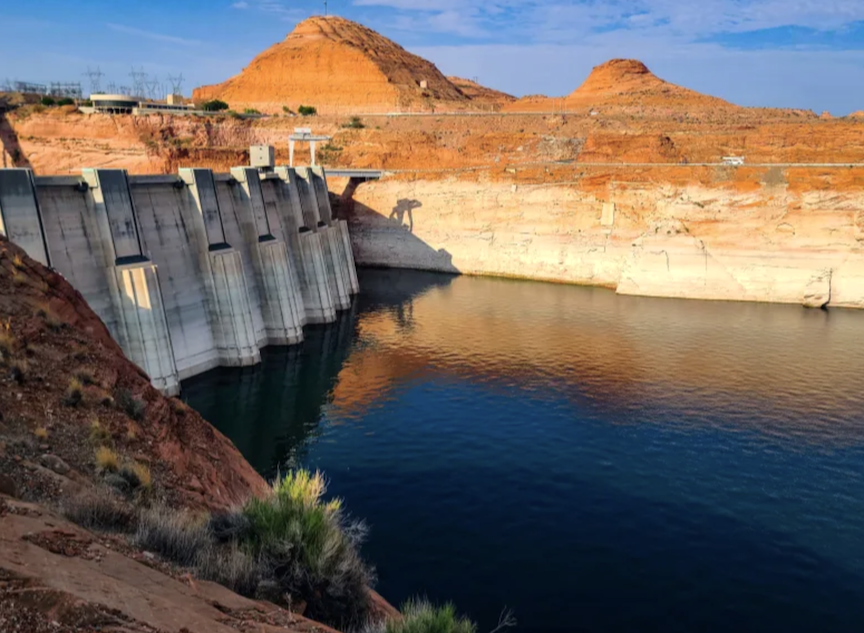
Gebhart shared that Lake Powell’s water level has recently increased by 1.2 million acre-feet, due to massive rainfall causing it to be 13 feet higher than previously projected at the end of October.
He also emphasized that Lake Powell’s capacity is still 600,000 acre-feet, or 9 feet, lower this year than last year, as releases are expected to rise by 1 million acre-feet, from 6 million to 7 million this year.
Gebhart concluded by stressing that a large snowpack this year could help recovery tremendously.
“We are hoping for a good year so that we can recover that water back in our upstream units,” he said. “I’m just gonna close by saying I’ve always said that our enemy is hydrology. It still hasn’t become our ally, but this increasing rain definitely helped.”
Christopher Brown, a senior assistant attorney general within the Water and Natural Resources Division, then detailed the ongoing litigation between Nevada and the federal government relating to the current framework.
The Colorado River Basin agreement between the seven states has been in flux due to the 2007 Interim Guidelines and the 2019 Drought Contingency Plan both expiring at the end of 2026. Negotiations between states began in 2023 to find a long-term successor plan, but have not been successful up to this point, which led the federal government to step in and impose a 10-year “Decision Framework,” which would last from 2027 to 2036.
Brown explained that the goal of each state was to reach a consensus and move forward to avoid litigation or the federal government stepping in.
“We were unsuccessful in trying to bring that forward, even though I think all seven basin states had described their desire and their opinion that that was by far the best potential outcome,” he said.
Brown described the federal plan as a broad framework to work within.
“It just paints with broad strokes, kind of the sideboards of what the operations might be for the next 10 years,” he said.
The federal plan includes heavy mandatory water cuts for the Lower Basin states of Nevada, Arizona and California, but includes no cuts for the Upper Basin states of Colorado, Utah, New Mexico and Wyoming.
Overall, Lower Basin states will lose 1.25 million acre-feet annually.
Nevada filed suit against the plan because of the potential impact it could have, as it would cut 50,000 acre-feet, or 17% of the state’s allocation over the next two years. The cuts could become even more severe based on the river’s condition, possibly causing the state to lose 71% of its overall allocation; a cut of that size would decrease the state’s allocation below its actual use.
Nevada already has the lowest allocation of any state in the Colorado River Basin, receiving just 1.8% of the total apportionment.
Arizona later joined Nevada’s suit, as both states argued that each state must equitably share the responsibility, between both Upper Basin and Lower Basin states, rather than the Lower Basin bearing the brunt of the cuts.
Brown did not want to disclose Wyoming’s legal strategy in a public meeting, but he stressed that they are keeping every potential option open and staying in close contact with the other Upper Basin states.
“We certainly are going to do whatever it is we need to do to protect Wyoming’s interests associated with these claims,” he said.
Committee co-Chair Rep. Martha Lawley, R-Worland, expressed her concern about this lawsuit putting the final decision concerning this entire process into the hands of a judge.
“We would end up in a situation where a federal court in the state of Nevada will be taking over the management of really the job of the Bureau of Reclamation,” she said.
Brown agreed, and stated that in his view, the only court that should be attempting to address these questions is the United States Supreme Court.
He concluded by emphasizing the enduring goal of finding consensus among the states without litigation.
“We have informed all of our partners in the Basin that that is still where we’re at,” Brown said. “And that is what we’re going to continue to do to the extent that we can find a resolution that doesn’t require a litigation result.”
The committee also discussed House Bill 135, which was proposed by Rep. Ken Chestek, D-Laramie. If passed, it would limit the amount of water used by data centers to 0.2 liters of water per kilowatt, and would include reporting requirements to ensure compliance.
Chestek acknowledged that this was a novel concept, as while many states have enacted laws that require data centers to report water usage, none, to his knowledge, have set a limit.
Sen. Stacy Jones, R-Rock Springs, questioned whether it is necessary for the Legislature to interfere, as many counties are creating their own rules to monitor data centers.
Chestek stressed that the Wyoming Constitution makes clear that water is owned by the state, and that its use is limited to beneficial uses.
“The state therefore has an interest in making sure that the water is preserved and used appropriately and not wasted,” he said.
Sen. Brian Boner, R-Douglas, suggested amending the bill so that the scope could be broader to include other power generation methods.
Chestek was open to the idea and explained that the bill was limited to data centers because of the level of public interest there has been.
Sen. Gary Crum, R-Laramie, agreed with Chestek that the Legislature would need to craft legislation to manage data centers, but he did not think this particular bill was ready.
During public comment, Khara Boender, who serves as the director of government affairs for the Data Center Coalition, expressed her concern about the legislation and its potential impacts on data centers.
“There’s no one-size-fits-all,” she said. “Water and energy efficiency involve engineering trade-offs and rigid mandates, therefore, present challenges.”
The bill was voted down by the committee and will not advance to the committee’s final meeting of the interim Dec. 17.
The 69th Wyoming Legislature’s general session is scheduled to begin Jan. 12.