
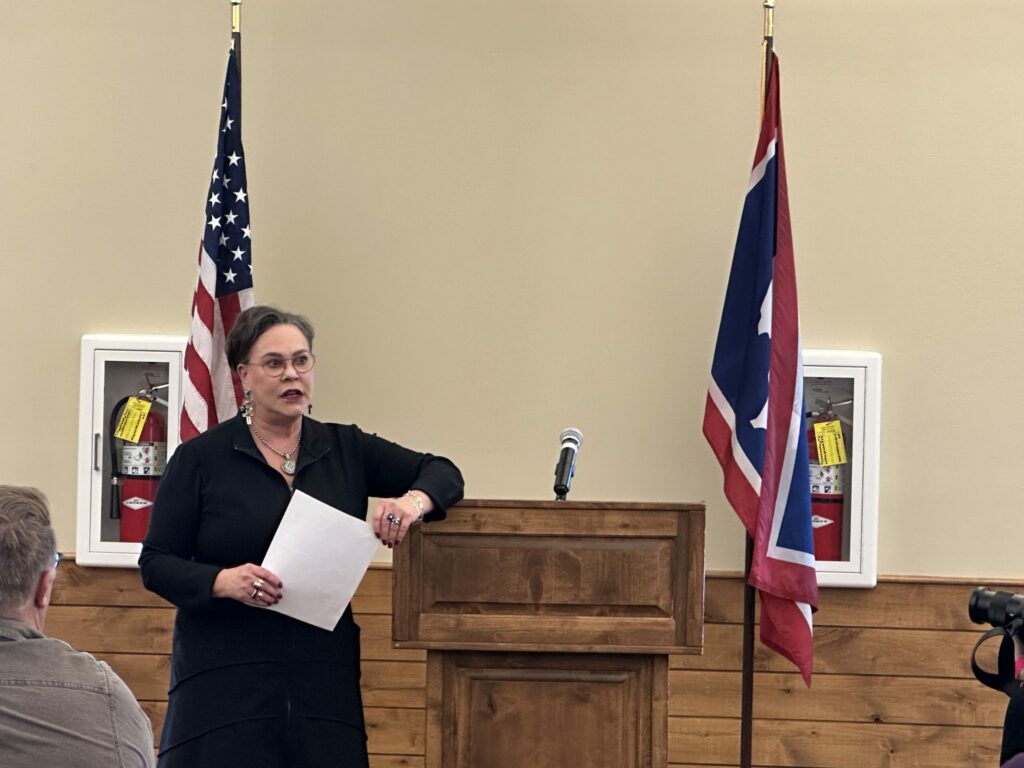
Unites States Representative and U.S. Senator -Elect Harriet Hageman (R-WY) called into the Weekday Wake-Up on Thursday, November 11 to discuss her transition into the Senate and what she hopes to accomplish in the House before the end of the year.
(0:00) Heading into this guest interview segment for right now this morning in the monthly report from Congresswoman Harriet Hageman today. Good morning (0:07) Representative, how are you? (0:09) I’m wonderful Duke. How are you? Are you doing fantastic? Thank you so much for the time as always and (0:14) Official congratulations first time you and I have chatted since the election and and off to the US Senate (0:20) Yes, thank you.
I’m so honored (0:22) I’ve been I’m honored to represent (0:24) Wyoming in the US House and I and I’m looking forward to moving over to the Senate as well (0:29) Tell us about that transition and what that’s like as you move into the seat (0:33) Of course held by Senator Lummis for for a number of term a number of years and how does that transition take place? (0:40) So right after the election the following Monday and Tuesday (0:44) We had orientation back here and at that time we learn all kinds of things you you get (0:49) You know information about your office and all of that (0:53) I’m actually already moved over into temporary office space in the heart Senate office building (0:59) They move us out pretty quickly because they have to get the House offices ready for the new class that’s coming in starting in January (1:06) So we’ve gone through orientation. I’ve had an opportunity to meet several times with my fellow senators, which has been wonderful (1:13) everybody has been extremely welcoming and helpful and (1:17) We’re just moving forward with I’m voting on the House side (1:21) I’m still wrapping things up over there, but I’m already out of my office and and on the Senate side (1:27) all right, so (1:29) You mentioned still as you go through this transition (1:32) You still are a member of the house for the next month and a half (1:35) And so what are some things that are going on right now that you’d like to see accomplished before the end of the year when? (1:40) that transition happens (1:42) So yesterday with the House Natural Resource Committee of which I am a member we did (1:48) unanimously consent on releasing a variety of bills that have been (1:53) Agreed to on the in the in the house on the Natural Resources Committee so that hopefully we can bring them to the floor (2:00) The other big thing there’s there’s a couple of big things that are happening back here (2:05) One of them is the permitting modernization that is taking place. It’s being debated on the Senate (2:11) It is a bipartisan bill.
We’ve had as many as 73 votes in this (2:16) a (2:18) Affirmative votes from senators in this at in the Senate in support of this bill (2:24) And this is something that has been worked on for decades (2:27) But we often talk about how slow permitting is how expensive it is to build anything in this country (2:33) And so as a result (2:36) This actually originated largely as the speed act in the House of Representatives (2:41) Again coming out of the Natural Resource Committee. I was a co-sponsor of that (2:46) But we are hoping that we are going to be able to get this through before the end of the year (2:51) This modernizes NEPA, the National Historic Preservation Act, some Clean Water Act, some Clean Air Act (2:58) Provisions as well as some provisions related to the Endangered Species Act, you know (3:03) the United States is notorious for being very very very slow and (3:08) being very expensive in terms of permitting infrastructure projects whether it be a pipeline or (3:13) A highway or a new road or a bridge (3:17) or any kind of energy infrastructure (3:20) And so we have if we’re going to compete if we’re going to continue to compete with China and other countries (3:26) We are going to have to get better at this and this modernization will help to do that (3:30) Congresswoman as you talk about that and try to get that done before the end of the year in the house (3:35) I know a lot of your time in Congress has been with public lands and natural resources and and those types of topics (3:41) I assume you expect to carry that over into the Senate as well (3:45) Or what will your responsibilities be and how will they be different in the Senate side? (3:50) so I (3:51) There will be differences in terms of my authorities and responsibilities (3:55) I am seeking to be on both the Judiciary Committee as well as the Environment and Natural Resources (4:02) I (4:03) The excuse me Environment and Public Works the EPW committee (4:08) So it has some of the same jurisdiction as the Natural Resource Committee in the house side does now (4:13) But it also has some more expanded authority as well (4:16) So those are the two primary committees that I’m also looking at potentially the Commerce Committee as well as (4:24) small business or (4:26) Indian Affairs and we will know after Thanksgiving more about our committee assignments in terms of the differences (4:33) I’m obviously on Judiciary in the House of Representatives (4:36) but on the Senate side the Judiciary is responsible for vetting judges and (4:41) As your listeners know I was a trial attorney for several decades prior to coming back here (4:46) Most of my work was actually in federal court (4:49) So I have a pretty good handle on what makes a good federal judge (4:52) But I also have a pretty good handle on what makes a really bad one (4:55) And so I will have the opportunity and the responsibility to engage with nominees to discuss with them their history (5:02) their background and their suitability to be on the federal bench and (5:06) then the other part that we do in the Senate that we don’t do in the house and that is vetting the (5:11) proposed agency heads the nominees to head EPA and Forest Service and Fish and Wildlife Service and (5:19) BLM and that sort of thing so I will have that responsibility and again having worked on federal issues federal land issues federal water issues (5:28) For the many decades that I did I will look forward to having the (5:32) Opportunity to make sure that these agency heads when they’re nominated or when they’re put in place (5:37) Really understand the importance of the Wyoming issues (5:40) Congresswoman when you talk about the importance of those Wyoming issues and how the (5:45) Election turned out here in the midterms and you’re going into a Senate that will now be (5:48) Majority under Democrat House is also flipped and will be majority Democrat (5:54) After the midterms and so when you talk about the (5:59) The changes that were made to benefit Wyoming resources, especially coal in the in the coal industry (6:05) specifically is there concern that maybe that’s going to take a step backward now or (6:10) What how do you see that moving forward? (6:13) Well, there is a concern (6:15) Because you know right now and in this last election (6:19) One of the things that the Democrats ran on is this word of affordability that they talked a lot about affordability (6:25) But affordability comes down to infrastructure and that’s why this permitting bill is so incredibly important (6:31) if we don’t have the infrastructure to produce things or to (6:35) Make things were to store water and that sort of thing if we don’t have the mines to mine coal (6:41) We’re not going to have affordable products on the other end (6:44) It’s just not possible to do and so I look forward to working with the Democrats if they are sincere about (6:50) Addressing affordability and the cost issues (6:53) We can produce all the oil and gas that we need in the United States with a lot of it coming from Wyoming (6:59) Yet and but it was the Democrats that killed killed the Keystone XL pipeline (7:05) We have the oil and gas, but we don’t have the refining capacity to refine it. There’s a shortage of refining capacity worldwide (7:12) We have not built a new refinery in the in the United States since 1978 now (7:18) We’ve expanded some every time they do a turnaround (7:20) There’s some has been some expansion, but California is trying to shutter two of the only refineries (7:26) They have left in the state (7:27) So it’s no wonder that gasoline is $8 a gallon in California because they have really bad policies about infrastructure (7:35) So I want to walk through the front that would work here and I want to build more refineries (7:40) I want to build more pipelines (7:42) I want to better manage our national forests so that we can produce our own (7:46) Timber and lumber domestically rather than having to import it which has also increased the cost of housing (7:51) I want to build water infrastructure in the state of California to meet their water demand (7:57) And so that they stopped looking to the Colorado River to solve all of their needs (8:02) California has been at war with their farmers and ranchers and their and their dairy producers for decades as they have taken water for (8:11) Producing crops and converted it into municipal water because they won’t build the infrastructure to meet the demand (8:17) So if this is all about affordability and I want to make sure that we have a policy of abundance rather than scarcity (8:22) Then we need to build infrastructure and I’m front and center to do that (8:27) so I want to walk in the door and I want to talk about what we need to build to meet the needs and the (8:32) Demands of the American people (8:34) U.s. Representative Harriet Hageman on the weekday wake-up senator-elect joining us this morning.
Thank you so much for your time as always anything else (8:41) You’d like to bring up while we have you on the air today (8:44) No, but I just I want to thank everybody. I want to thank your listeners (8:48) I want to thank Western Wyoming (8:50) For the support that you’ve given me the faith that you have placed in me in terms of being your u.s. (8:55) Representative and now the senator-elect (8:59) Wyoming is always at the forefront of my mind and every decision I make is (9:02) Is it is is colored by what is in the best interest of my state? (9:08) What is in the best interest of my fellow citizens? (9:10) And I just want to thank everybody for putting your submit for giving me your support putting your faith in me (9:15) And I won’t let you down u.s. Representative and Senate elect Harriet Hageman on the weekday wake up this morning (9:21) It’s all part of the SBI radio network