
• Last week’s fire was one of three fires over 10 acres in forest’s history.
By Christina MacIntosh
Jackson Hole News&Guide
Via- Wyoming News Exchange
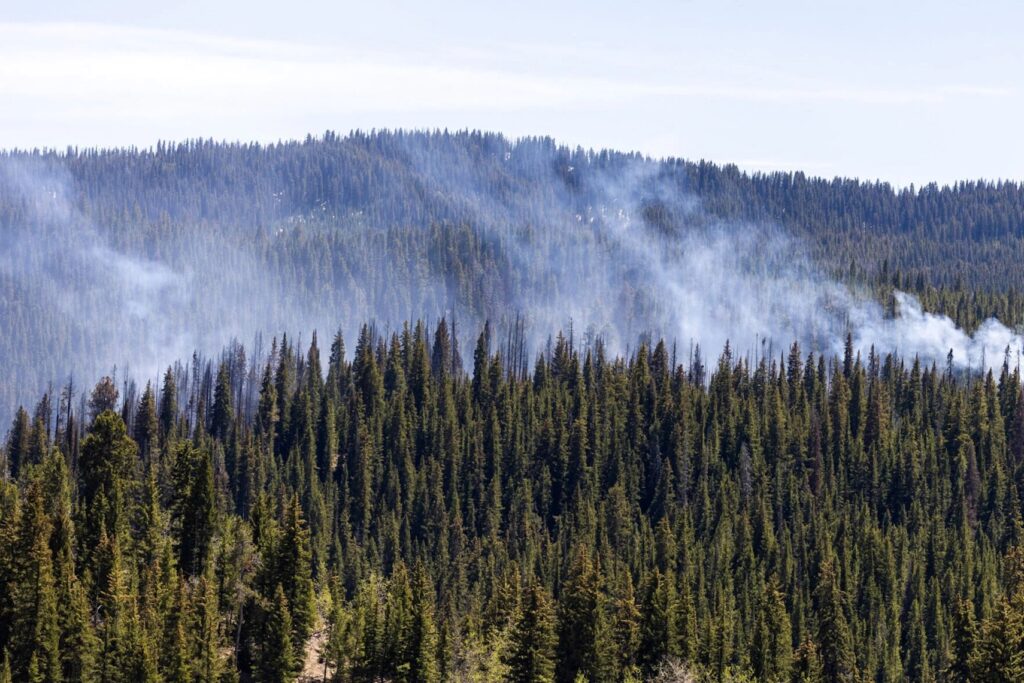
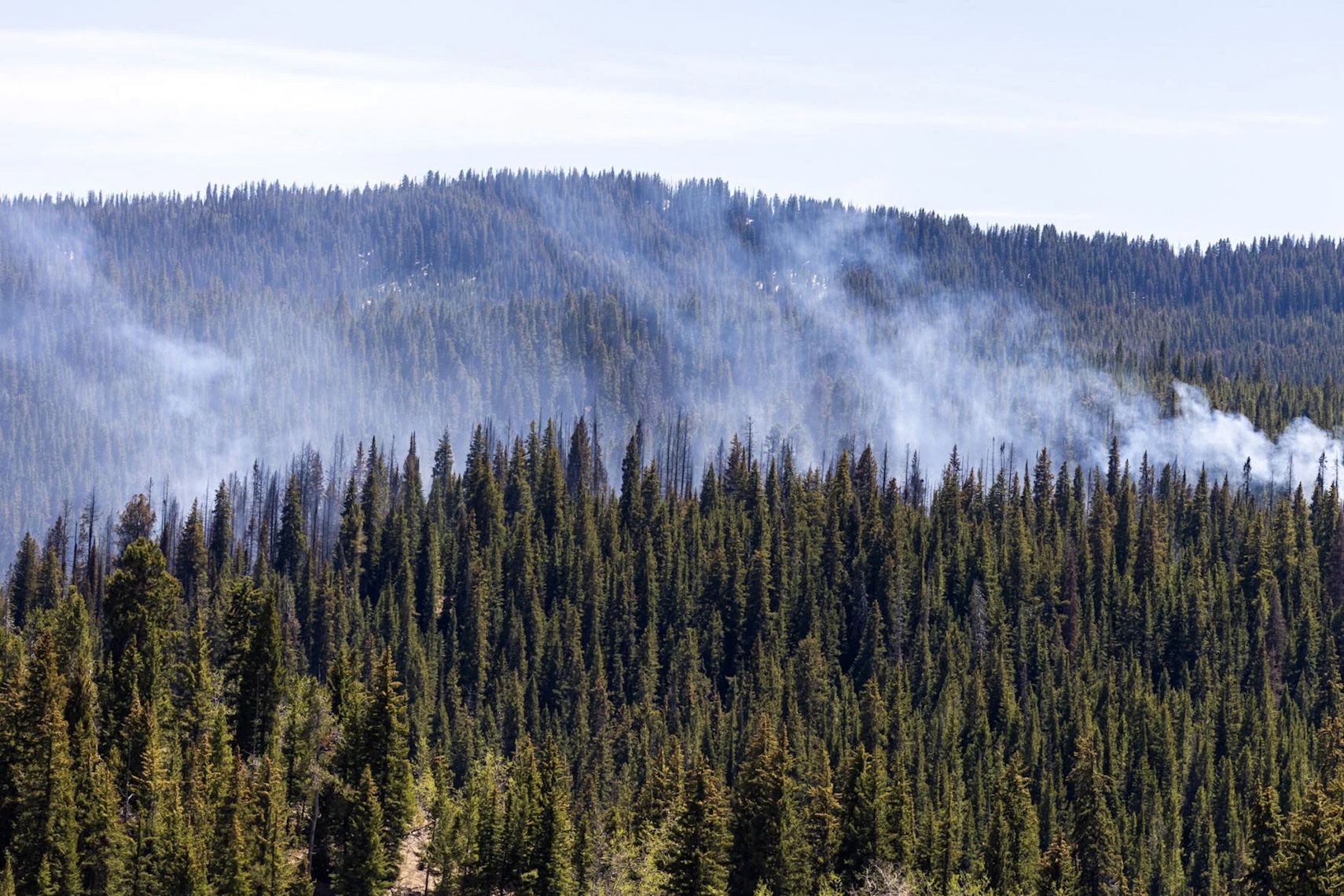
JACKSON — Last week, the Spread Creek Fire torched roughly 250 acres near Togwotee Pass, becoming the largest May wildfire ever recorded on the Bridger-Teton National Forest.
Fire managers have taken notice, and are anticipating restrictions later this summer.
“Let’s just say, I’m preparing the paperwork,” said Jackson Hole Fire/EMS Chief Mike Moyer.
In addition to setting a Bridger-Teton record for the month, the Spread Creek Fire was the third recorded wildfire of more than 10 acres to burn on the forest in May.
A 157-acre wildfire of undetermined cause broke out on May 22, 1984, according to forest spokesperson CJ Adams. About three decades later, the 2015 Phister Fire, at 20 acres, became the most recent wildfire of more than 10 acres to burn this early in the year. Like the Spread Creek Fire, that blaze followed a low-snow winter, according to National Resources Conservation Service data.
The lightning-caused Spread Creek Fire broke out on May 13 and was 100% contained by Tuesday morning.
The blaze substantiated fire managers’ concern about an early wildfire season due to low snowpack and early melt and indicates that should conditions stay dry and warm, there will likely be a busy fire season to come, officials said.
The fire broke out about four to five weeks ahead of the typical fire season, said Dave Wilkins, Bridger-Teton’s north zone fire management officer. Fire conditions are elevated for this time of year, he said.
Last week’s fire came before Teton Interagency Fire, which fights fires on the Bridger-Teton and in Grand Teton National Park, received its contracted helicopter for the fire season. That helicopter is set to arrive on June 1. Fire managers used the Teton County Search and Rescue helicopter to fight the fire instead.
The Spread Creek Fire was early for a wildfire that requires lots of resources, said Moyer. Fire managers used the helicopter, two Super Scooper airplanes, drones, four fire engines, hotshot crews, suppression crews and an initial attack crew to suppress and contain the fire.
Dry? Or monsoonal?
The National Weather Service’s three-month outlook is concerning fire managers. It anticipates above-average temperatures and below-average precipitation in Teton County in May, June and July.
“We could be in for a long fire season with the predicted above average temperatures,” Wilkins said. “It’s predicted to be a real hot summer this year, so people should exercise caution.”
The federal agency is set to release an updated outlook for June, July and August on May 21.
Outlooks are different than forecasts in that they are probability based, said Mike Matoli, a Wyoming-based meteorologist for the National Weather Service. Outlooks are based on big picture climatic phenomena across the planet; they can’t say that anything is impossible or guaranteed, because short-term weather phenomena can’t be predicted far in advance.
Outlooks are like a weighted dice, Matoli said.
“A certain outcome might be a little more likely, but still any outcome is possible,” he said.
Those predictions are better than coin flip, but they don’t come true as frequently as a regular forecast.
The May segment of the outlook appears to have come true. The whole state has been warm so far this month and the northern part of the state has been warm and dry, Matoli said.
Teton County firefighters are particularly concerned about sagebrush and grass on south-facing slopes that haven’t seen much moisture and are seeing longer days and lots of sun, Moyer said.
Generally, there’s a fine line between receiving enough precipitation to keep vegetation from getting too dry and getting so much precipitation, followed by sun, that fuels grow rapidly, Moyer said. If vegetation grows a lot during a wet spring and a dry July and August follow, the plants can become an abundant fuel source for lightning- and human-caused fires, he said.
In the updated outlook set to be released Thursday, there’s the potential for a decent monsoon this year, Matoli said. The outlook will still favor above average temperatures, but there may be more precipitation than initially expected. A strong enough monsoon can push moisture into northwest Wyoming.
“That could perhaps save us a little bit,” Matoli said.
Coming restrictions?
Fire managers, for their part, have capitalized on last week’s fire to raise awareness about fire season.
“Life is busy, and everybody has a lot to do in life, especially in Jackson Hole in the spring and the summer,” Moyer said. “Anytime that there’s a little bit of smoke in the air and we have people’s attention momentarily, we would love it if people would take a few minutes to visit our website.”
Moyer advises people to sign up for Teton County’s emergency notifications, pack an evacuation bag, understand what evacuation from a wildfire entails and spend time making their home more fire safe.
Fire bans are not yet on the table, Moyer said.
Historically, Teton County has “gotten serious” about bans at the beginning of July, he said. Once conditions on the ground indicate that fire managers need to be concerned about fire risk, county officials will begin meeting with state and federal partners weekly to discuss fuel moisture and weather reports.
Fire managers will have to see how much moisture Teton County gets this spring before seriously discussing restrictions, but the county fire department has begun having internal conversations about preparing for wildfire season, including ensuring it has adequate staffing and creating contingency plans.
“The fact that we’ve had several small fires from open burning that have escaped, and the fact that we’ve had this fire up north, got our attention,” Moyer said. “We’re leaning in to be prepared.”
The above story may be used ONLY by members of the Wyoming News Exchange or with the express consent of the newspaper of its origin.