Lebanon’s president will meet with Trump in Washington to push for Israeli troop withdrawal
By AP
July 21, 2026
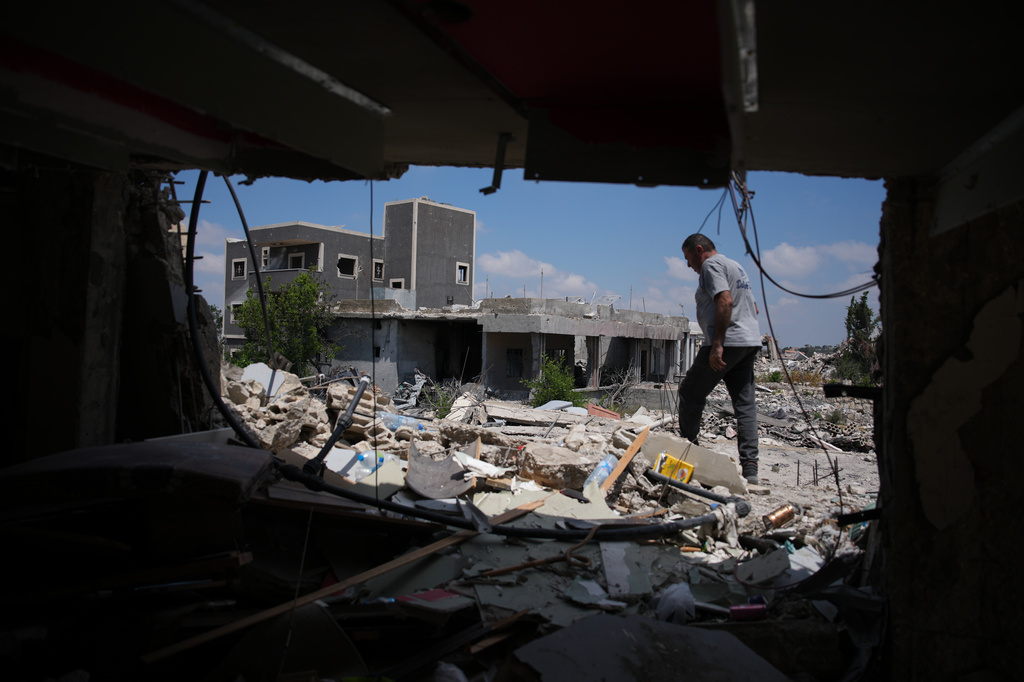
A resident inspects the damage to his home, destroyed in an Israeli airstrike during the Israel-Hezbollah war in Ghandouriyeh village, southern Lebanon, Tuesday, July 21, 2026. (AP Photo/Hassan Ammar)
By KAREEM CHEHAYEB Associated Press
BEIRUT (AP) — Lebanon’s president will meet with U.S. President Donald Trump on Tuesday to wrap up a four-day visit to Washington, in a bid for long-term calm after months of war at home between Israel and the Iran-backed Hezbollah militant group.
Joseph Aoun’s first-ever meeting with Trump comes as Lebanon and Israel hold rare direct talks mediated by Washington. This is the first visit by a Lebanese president to the White House since 2009.
Lebanon hopes the talks will result in Israeli troops withdrawing from large swaths of southern Lebanon that they currently occupy, and the Lebanese military receiving support to assert full control in areas where Hezbollah militants had held sway.
Lebanon and Israel announced a “framework agreement” on June 26, setting a plan for Israeli forces to withdraw and for the disarmament of Hezbollah, which for decades had a strong presence in southern Lebanon. It also lays out steps toward an eventual peace agreement between the countries, which have never held formal diplomatic ties and have been nominally in a state of war for nearly 80 years after Israel’s establishment.
The U.S. State Department announced Monday that operations in three villages deemed part of a “pilot zone” had begun, without giving details. Two of the villages, Froun and Srifa, are not under Israeli military control and the Lebanese army is present, while Israeli forces are in part of Zawtar al-Gharbieh.
The Lebanese army in a statement said it was preparing for Israel to withdraw from Zawtar al-Gharbieh and that it had begun deploying troops Tuesday. The Israeli military said it “will adjust its force posture in one of the pilot areas in order to enable the Lebanese Armed Forces to carry out their mission,” without specifying the location.
The Lebanese military later said Israeli troops fired near that area in Zawtar al-Gharbieh, without giving details, and warned it could delay deployment.
An Israeli military official, speaking on condition of anonymity in accordance with military guidelines, said the withdrawal had not yet begun.
Village mayor waits for safety to be confirmed
Abed Ezzeldine, mayor of Zawtar al-Gharbieh, said they were waiting for the Lebanese military to say whether it’s safe for residents to check on their homes after they fully deploy and patrol the area. He was concerned about safety, given that the Israeli military is still present in a village next door, while Israeli strikes continue nearby.
“The villages are intertwined, so we don’t feel safe because the Israelis are present there, they’re on our borders and are not very far from us,” Ezzeldine told The Associated Press, who said Zawtar al-Gharbieh is uninhabitable.
“Once the army gives us permission to enter Zawtar al-Gharbieh, we as civilians will go in, but only to check it out and see how things are and then we will leave,” he said. “We can’t stay because the infrastructure is completely damaged and houses have been leveled. They (the Israelis) have bulldozed the roads.”
The Lebanese military last week increased its presence in some of the areas expected to be included in the pilot zone, including the three villages, with troops patrolling and setting up checkpoints.
Rubio says US will support the framework agreement
Aoun on Sunday met with Secretary of State Marco Rubio, who said Washington will continue to endorse the Lebanese agreement and support its full implementation. Rubio described the meeting as “very positive” and warned that Lebanon will “never be fully at peace” as long as the Hezbollah issue is not resolved.
“How do you replace Hezbollah? You defeat and replace them with a government that is strong enough to be the sole force of arms in the country,” Rubio said.
Skeptics in Lebanon fear that a military confrontation with Hezbollah could lead to a civil war.
Government officials have urged investment in the country’s battered infrastructure to empower the weakened state, which Rubio echoed.
“This is not just about military stuff,” he said. “This is about how can we attract more U.S. and international investment into Lebanon.”
Israel plans on a long-term presence
Israeli officials, meanwhile, have said they plan to keep military forces long-term in a “security zone” in southern Lebanon.
Hezbollah has dismissed the U.S.-brokered direct talks and instead backed Washington’s talks with its key ally and patron Iran to end their war, which includes ending the war in Lebanon as a condition.
Lebanon’s government came to power on a reformist platform in early 2025, vowing to disarm all non-state groups including Hezbollah. It blames Hezbollah for dragging the country into another war with Israel in March, when the militant group fired several rockets toward northern Israel two days after the U.S. and Israel attacked Iran.
Beirut’s leadership, however, has condemned Israel’s subsequent ground invasion and massive aerial campaign in the country, which has killed over 4,000 people and displaced 1.2 million others.
While grappling with stark political opposition from Hezbollah and allies within the deeply divided country, Lebanon’s leadership insists that Israeli withdrawal and international financial support for Lebanon’s cash-strapped army is crucial for a sustainable security solution.
___
Associated Press writer Giovanna Dell’Orto in Jerusalem contributed.